
Maps on Maps: The Next Evolution of Travel Discovery
Maps on Maps is a new way to explore cities. Instead of searching for places, SearchSpot layers cafes, parks, lakes, and attractions on one intelligent map.

The Moment I Realized Travel Maps Were Missing Something
A few months ago, while working on SearchSpot, I noticed something strange about how people explore cities.
When travelers plan a trip, they open a map. Most of the time that map is Google Maps.
They search for things like:
- “cafes near me”
- “best restaurants in Bali”
- “tourist attractions in Rome”
And the map shows exactly what they asked for.
But that’s where the problem begins.
Because travelers don’t actually think in search queries.
They think in experiences.
For example:
“I want to go for a run near a lake and then grab a coffee somewhere quiet.”
Or:
“I want a nice place to work with good coffee and a good view.”
Traditional maps don’t understand this.
They show places based on keywords, not intent.
That small gap between what people ask for and what they actually want to do is what led us to build something different at SearchSpot.
We call it Maps on Maps.

The Problem With Traditional Maps
Modern maps are incredible pieces of technology. They can help you navigate across cities, discover restaurants, and even check live traffic.
But when it comes to travel discovery, they still operate with a very simple logic:
Search → Results.
If you search for cafes, the map shows cafes.
If you search for hotels, it shows hotels.
Each search shows one layer of the city at a time.
But when people explore cities, they don’t think in isolated layers.
A traveler exploring a neighborhood might be thinking about several things simultaneously:
- Where can I grab coffee?
- Is there a park nearby?
- Are there good walking routes?
- Are there interesting spots around this area?
In reality, travel is a combination of experiences happening in the same space.
But traditional maps force users to search one category at a time.
This makes exploration slower and less intuitive.
Why Travel Discovery Is Broken
Another common solution the travel industry tried to build was itinerary generators.
You’ve probably seen them before:
- “Your perfect 5-day Bali itinerary.”
- “The ultimate 7-day Europe plan.”
They look polished and structured.
But most travelers quickly realize something important.
These itineraries often look better on paper than in real life.
They are often:
- Too rigid
- Overpacked with activities
- Designed without understanding how people actually move through cities
Travel doesn’t happen in perfectly structured blocks.
You might discover a café you love and stay there for two hours.
You might wander into a neighborhood that wasn’t on your plan.
You might wake up one morning and simply want to explore without a schedule.
Traditional travel tools either give you rigid itineraries or basic search results.
Neither truly supports how travelers naturally discover places.
Introducing “Maps on Maps”
This is where the idea of Maps on Maps emerged.
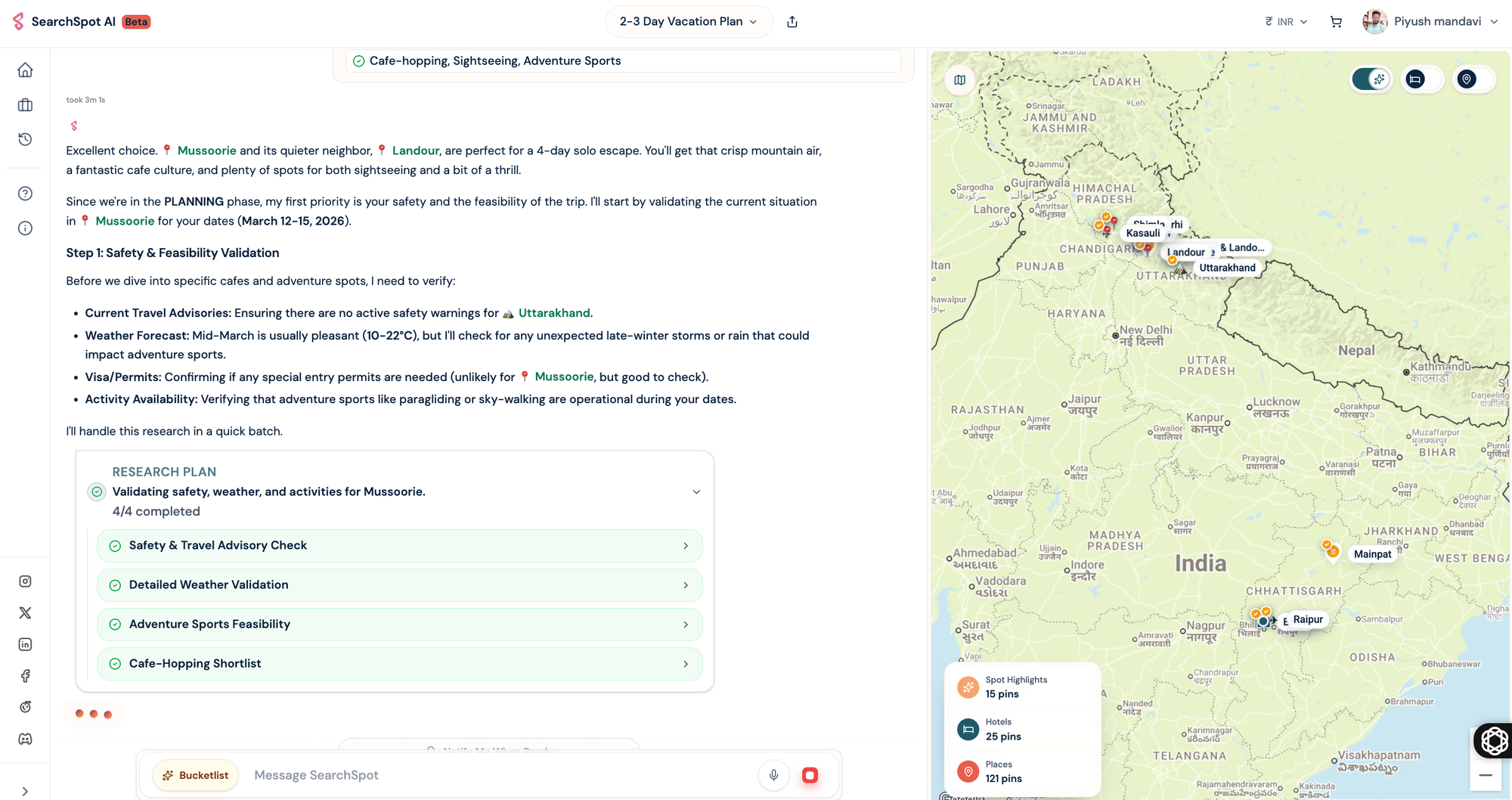
Instead of showing a single category on a map, SearchSpot layers multiple contextual layers onto one intelligent map.
Think of it like stacking different perspectives of a city on top of each other.
For example, imagine you ask:
“I want a quiet place to work with good coffee near a lake.”
Instead of showing a simple list of cafes, SearchSpot displays a layered map showing:
- Cafes with good work environments
- Lakes and waterfront areas
- Walkable routes nearby
- Nearby attractions or parks
All visible on one interactive map.
This is the core idea behind Maps on Maps.
Instead of searching for isolated locations, travelers can see how different places connect to each other.
It turns a static map into something closer to a discovery engine.
Real-World Use Cases of Maps on Maps
Once we started building this feature, it became clear that it unlocks entirely new ways to explore cities.
Here are a few scenarios where Maps on Maps becomes incredibly useful.
The Morning Runner
Imagine a traveler waking up early in a new city.
They don’t want to plan a full itinerary. They just want a good start to the day.
They ask:
“Show me places to run near water with coffee nearby.”
The map instantly highlights:
- Lakeside running routes
- Nearby parks
- Cafes within walking distance
Now the traveler can start their morning naturally — run, relax, and grab coffee — without switching between multiple searches.
The Remote Worker
Remote work has changed how people travel.
Many travelers now look for places where they can work and explore at the same time.
Instead of searching for “cafes near me,” a user might ask:
“Find a calm café where I can work with a good view.”
The map highlights:
- Work-friendly cafes
- Scenic areas nearby
- Quiet neighborhoods
The traveler can now choose a place that isn’t just functional but also enjoyable.
The Curious Explorer
Some travelers prefer to explore without strict plans.
They simply want to wander and see what the city offers.
With Maps on Maps, a traveler can see multiple discovery layers at once:
- Hidden cafes
- Cultural attractions
- Parks and walking routes
- Interesting neighborhoods
This turns the map into a living guide to the city.
Instead of searching repeatedly, travelers can visually explore possibilities.
Why AI Travel Discovery Is the Next Big Shift
Travel technology is evolving quickly.
For years, the focus was on booking platforms and review websites.
Then came navigation tools.
Now a new category is emerging:
AI travel planners.
An AI travel planner doesn’t just show places. It understands what travelers want to experience.
Instead of typing rigid queries, travelers can express natural intent:
- “Show me sunset spots near the beach.”
- “Find good breakfast places near a running trail.”
- “Help me discover walkable neighborhoods with great cafes.”
AI systems can interpret these requests and generate interactive travel maps that match the traveler’s intent.
This type of smart travel planning is fundamentally different from traditional search.
It doesn’t just answer questions.
It helps travelers discover possibilities.
Why Maps on Maps Could Change How We Explore Cities
Cities are incredibly complex environments.
They contain thousands of experiences layered on top of each other:
- Food
- Culture
- Nature
- Workspaces
- Hidden neighborhoods
Traditional maps flatten this complexity into simple search results.
But Maps on Maps reveals how these experiences overlap.
It helps travelers understand the context of a place, not just its location.
Instead of thinking:
“Where is the nearest café?”
Travelers can think:
“Where can I have a great morning?”
Instead of:
“Show me attractions.”
They can ask:
“Show me neighborhoods worth wandering.”
When maps start understanding intent, travel discovery becomes much more natural.
A Small Shift That Changes Everything
Sometimes innovation doesn’t come from building something entirely new.
Sometimes it comes from looking at an existing tool differently.
Maps have been around for centuries.
Digital maps have been around for decades.
But if maps evolve from search tools into intent-driven discovery tools, the way we explore cities could change dramatically.
The idea behind Maps on Maps is simple:
Cities should be explored through experiences, not just search queries.
And the best travel moments often happen when the right layers of a city reveal themselves at the right time.
That’s the kind of travel discovery we’re trying to build with SearchSpot.